


Engaging All, Including Myanmar Govt and Arakan Army, to Resolve Rohingya Crisis
- Arakan Now

- Aug 26, 2025
- 2 min read
Arakan Now | 26 August 2025
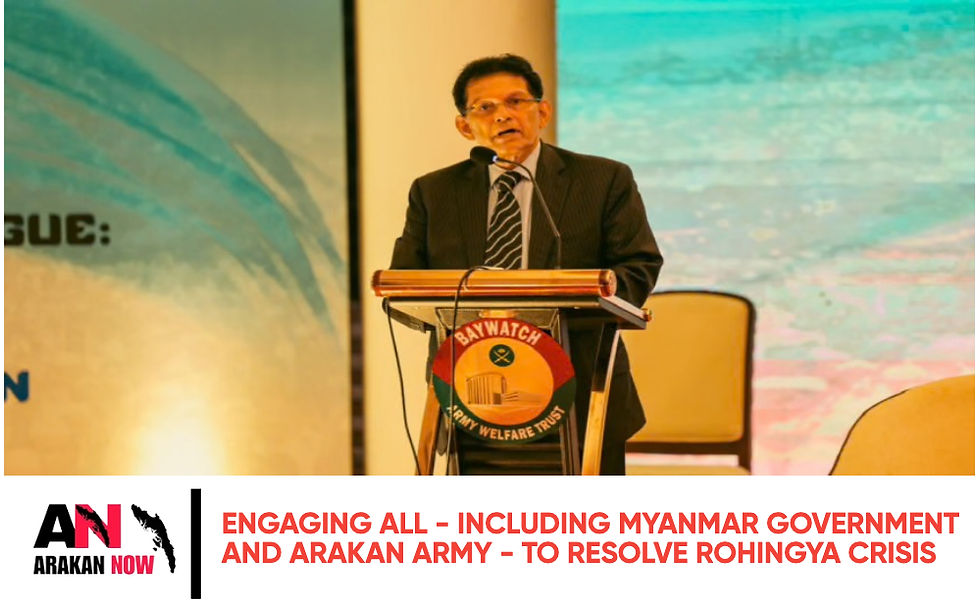
National Security Adviser and High Representative for the Rohingya Issue Khalilur Rahman today said the Stakeholders' Dialogue has once again reflected the Rohingyas' clear and unmistakable yearning to return to Myanmar.
He said the Rohingyas want to return to their homeland with dignity and safety, with the restoration of their rights and accountability for atrocities committed against them.
To address the crisis, Khalilur Rahman stressed his continued engagement with all key actors — including the Arakan Army and the Myanmar government. He noted that a solution cannot be achieved by leaving out any important actor, as negotiations must involve everyone in order to be effective. If one party is excluded, any agreement reached is likely to fail or collapse. He made these remarks while addressing the concluding session of the international conference “Stakeholders' Dialogue: Takeaways to the High-Level Conference on Rohingya Situation” held in Cox's Bazar.
Historic Rohingya Participation
Khalil underscored the historic participation of the Rohingya community at the dialogue, marking the first time they collectively presented their perspectives under one roof.
He added that the upcoming UN High-Level International Conference on the Rohingya issue will be held on September 30 at the UN Headquarters in New York. In preparation, the dialogue was organised to hear the voice of the Rohingya directly. Chief Adviser Prof Muhammad Yunus opened the session with a seven-point proposal that will shape discussions at the UN meeting.
Key Issues Raised
Khalil highlighted six major takeaways from the dialogue:
Rohingya aspirations for safe, dignified, and permanent return to Myanmar
Declining international aid threatening food, healthcare, and education
The need for trust-building among stakeholders
Concerns over criminal activities in Myanmar threatening regional stability
ICC processes continuing without delay from Bangladesh
The 1982 Citizenship Law and systematic persecution as root causes of the crisis
He said Bangladesh has submitted lists of 800,000 Rohingya, with Myanmar confirming over 180,000 as eligible for return — verification is ongoing.
Voices from the Dialogue
Panelists highlighted ongoing human rights violations in Rakhine, including indiscriminate attacks, arson, mass killings, rape, and forced conscription by both the Myanmar Armed Forces and the Arakan Army.
Participants also acknowledged Bangladesh’s generosity but warned of rising pressure on host communities and the environment in Cox’s Bazar and Bhasan Char. They urged stronger roles from neighbouring countries, ASEAN, the UN, and international partners.
Ismail Jabiullah, adviser to the BNP chairperson, recalled his experience as the first camp-in-charge of Kutupalong in 1978, saying the Rohingya crisis has placed a heavy economic and social burden on Bangladesh. He said the problem originated in Myanmar and must be settled with their initiative. He welcomed the government’s seven-point plan and regional engagement.
Asaduzzaman Bhuiyan Fuad of AB Party drew parallels with Afghanistan and Syria, urging pragmatic solutions such as the right to work and education while preparing for repatriation.
Mia Golam Porwar, secretary general of Jamaat-e-Islami, said Jamaat will remain firm in supporting humanitarian assistance, justice, and a sustainable solution for the Rohingya crisis.
Akhter Hossen of the National Citizen Party expressed solidarity, saying the Rohingyas must be given food, education, and basic rights until their safe return to Myanmar is ensured.
Source: The Daily Star


