
Experts urge coordinated strategy, regional engagement for Rohingya crisis

Nov 23, 2025
3 min read
Arakan Now | 23 November 2025
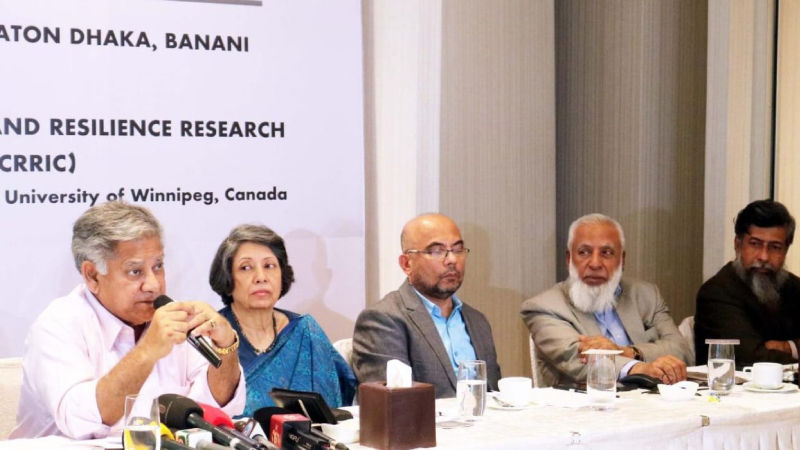
A high-level roundtable in Dhaka on Monday (November 17) highlighted the urgent need for a coordinated, long-term strategy to address the protracted Rohingya crisis, with experts emphasizing humanitarian, security, and regional dimensions of the issue. The event, titled “Charting Peace, Securing Borders: Bangladesh’s Post-Election Challenges in the Rohingya Crisis,” was jointly organized by the Foundation for Strategic and Development Studies (FSDS) and the Conflict and Resilience Research Institute (CRRIC) at the Sheraton Hotel. A MoU in “Advancing Knowledge in Conflict Resolution and Peace through Security” was also signed at the event.
Brig. Gen. (Retd.) M Sakhawat Hussain, adviser to the Ministries of Shipping and Labour and Employment, was present as the chief guest, while FSDS Chairman Maj. Gen. (Retd.) Fazle Elahi Akbar chaired the session. Participants included academics, policy analysts, government officials, and representatives from the Rohingya community.
The discussion focused on the escalating pressures of hosting more than 1.2 million Rohingya refugees in Cox’s Bazar. Experts warned that overcrowding, environmental degradation, crimes, transnational trafficking, and the growing risk of extremism threaten both local communities and national security.
FSDS Chairman Major Gen. (Retd.) Fazle Elahi Akbar stressed that although Bangladesh has ensured shelter, safety, and dignity for the Rohingyas on humanitarian grounds, the scale, duration, and nature of the crisis have placed immense pressure on national resources, local communities, and the overall security architecture. The meeting outlined 12 recommendations, including establishing a National Rohingya Strategy under a unified coordination framework, appointing a National Rohingya Response Coordinator, strengthening inter-ministerial coordination, and linking repatriation to broader regional development plans involving Myanmar, India, China, and ASEAN countries.
Speaking as the chief guest, Adviser Brig. Gen. (Retd.) M Sakhawat Hussain claimed that the Rohingya Crisis required a Track 1.5 diplomacy. He proposed that instead of a “two-state” solution, the Rohingyas should focus on a Mrauk-U frontier consisting of a self-administered region for the Rohingyas.
Brig. Gen. (Retd.) Shafaat Ahmed moderated the session. He called for a rights-based approach to ensure that repatriation recognizes the Rohingyas’ full rights in Myanmar. He called on the policy-makers to reaffirm their commitment to stability and a sustainable long-term solution
Dr. Kawser Ahmed, executive director of CRRIC, emphasized Bangladesh’s urgent need for a clear long-term strategy on the Rohingya crisis amid shifting regional geopolitics. He introduced the research-driven “Rakhine Reconstruction Plan” as a blueprint for a dignified future return.
Academics, including Professor Imtiaz Ahmed and Professor Amena Mohsin, outlined multi-phase, research-driven frameworks for linking repatriation with regional development, technology-driven border studies, and diplomatic initiatives. They emphasized public–private partnerships, multi-track engagement, and collaboration with Bangladeshi institutions as critical to achieving long-term solutions.
Professor Imtiaz Ahmed, executive director of the Center for Alternatives, outlined a five-phase framework for developing a comprehensive “Rakhine Reconstruction Plan”, linking Rohingya repatriation to wider regional development.
Professor ASM Ali Ashraf, chairman of the Department of International Relations at the University of Dhaka (DU), noted that the Rohingya crisis remained Bangladesh’s top foreign policy and regional security challenge. He called for a dedicated Special Envoy, coordinated strategy across all stakeholders, and inclusion of Track 2 actors to ensure meaningful repatriation and long-term peace in Rakhine.
Rohingya representatives stressed the urgency of international coordination. Sayed Ullah highlighted ongoing systematic persecution and the need for collective strength in engaging Myanmar, China, India, and ASEAN. Khin Maung warned that neither the Myanmar military nor the Arakan Army currently demonstrates genuine political will for resolution, posing long-term security risks for Bangladesh.
Government officials, including Mohammad Mizanur Rahman, additional secretary at the Office of Refugee Relief and Repatriation Commissioner (RRRC), who clarified long-standing misconceptions about population figures and inflow timelines, reaffirm that Bangladesh’s registration system provided accurate and scientific data. He urged the next government to establish a specialized body to lead policy, diplomacy, and regional engagement, and reiterated that repatriation and not integration in Bangladesh remained the only sustainable solution.
Other participants, including former IGP Ashraful Huda, BNP International Cell representative Zeeba Amina Khan, and former Ambassador Nasim Ferdous, called for stronger regional diplomacy, specialized institutional mechanisms, and innovative approaches to address stalled bilateral and multilateral efforts.
In closing, Dr. Isharaf Hossain, secretary general of FSDS, called for a comprehensive national strategy to align all stakeholders under a coordinated plan, warning that trial-and-error approaches over the past eight years have yielded limited progress and wasted critical time.


